
The Three Layers of Neuroinclusion at Work
The Three Layers of Neuroinclusion

Workplaces often make neuroinclusion sound bigger than it needs to be. People start talking about policy, training programmes, audits and culture change before they have looked at the meeting that moves three times in one week or the manager who gives every instruction verbally and then wonders why people remember different versions.
I think the better starting point is simpler. Look at what creates friction every day. Change what is obvious. Then look again.
That is where the three layers come from. They are not a formal standard and I am not pretending every workplace moves through them in a neat order. Real organisations are messier than that. The model is simply a practical way to separate three different jobs that often get thrown into one bucket called neuroinclusion.
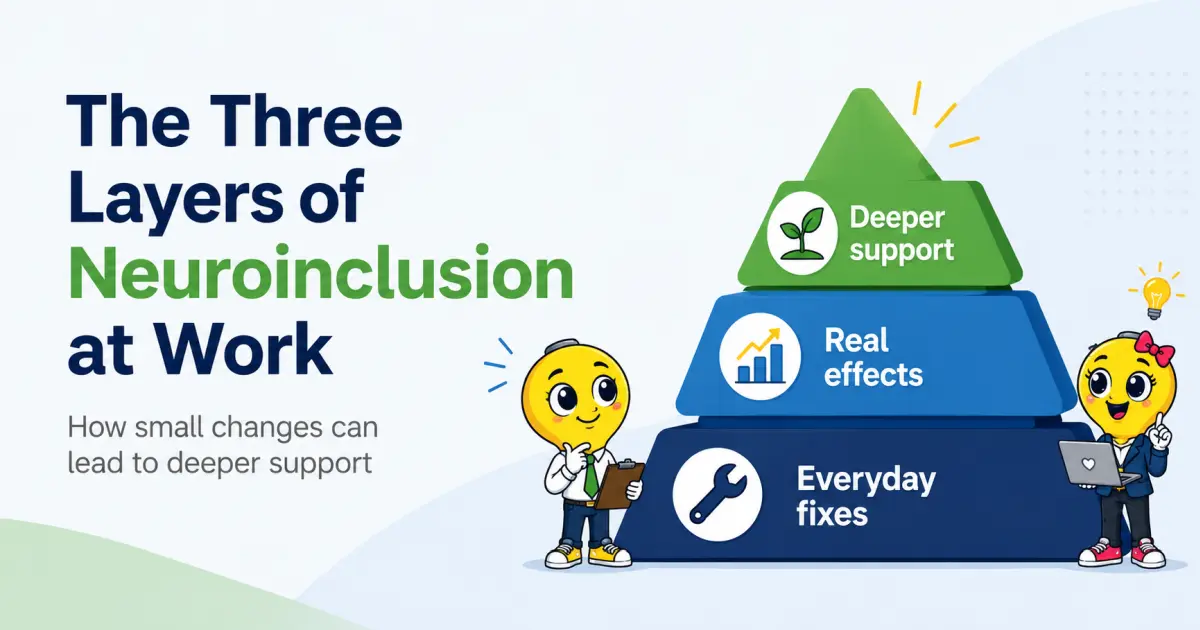
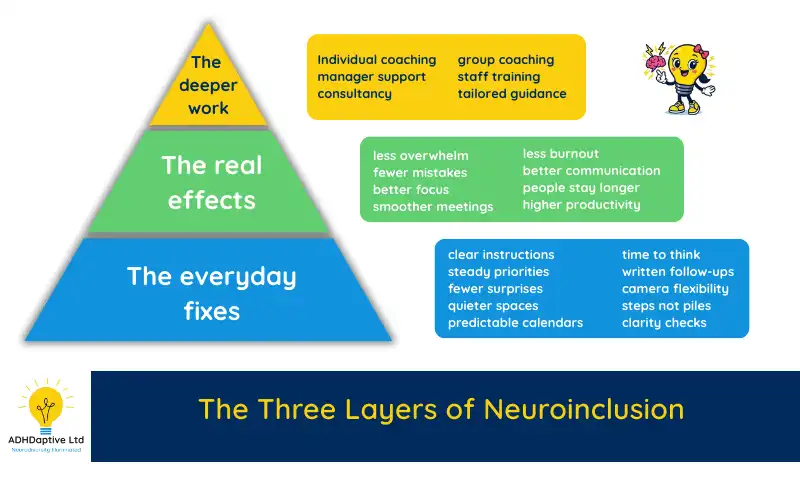
The first layer is about everyday working practices. The second is about noticing the patterns that remain once some of the obvious friction has gone. The third is about individual support and wider organisational change.
Starting with the first layer does not mean the deeper work can wait forever. It means you stop using a complicated answer for a problem that may begin with a vague email, an inaccessible meeting or a manager who changes the priority every afternoon.
Layer One: The Everyday Fixes
This layer is where I would start in almost any organisation. Not because it solves everything, but because bad everyday working practices create unnecessary problems for a lot of people.
Think about the ordinary points where work becomes harder than it needs to be. Instructions arrive verbally in a busy meeting. Priorities change, but nobody says which old priority can stop. A calendar invite has no purpose or agenda. A manager asks for urgent work and leaves the deadline to guesswork. The office has nowhere quieter to work. A person asks for clarity and gets told to be more flexible.
None of those problems needs a diagnosis before somebody can improve them.
- Clear instructions
- Written follow-ups after important conversations
- Priorities that are named and reviewed
- Meetings with a purpose and enough information to prepare
- Quieter work options where the workplace allows them
- Time to process before an immediate answer is demanded
- Clear deadlines rather than vague urgency
- Flexibility around cameras where seeing faces is not needed for the task
- Large pieces of work broken into visible stages
- A quick check that both sides understood the same thing
These are not glamorous changes. That is rather the point. Neuroinclusion can fail while people are designing a grand policy because the day-to-day experience of work has not changed at all.
A clear instruction can help an autistic employee who needs precision, a person with ADHD who loses part of a long verbal conversation, a new starter who is still learning the role, and a tired manager who simply wants to know what has been agreed. One change can remove different kinds of friction for different people.
There is a limit to this layer, though. Better general practice does not mean everybody now has what they need. Some people will still face barriers. That is why there are three layers, not one.
Layer Two: The Patterns You Start to See
This is the part that was missing from the simpler version of this article. I used to describe layer two mainly through positive effects such as less overwhelm, fewer mistakes and better communication. Those may happen, but that description was too neat.
The more useful middle layer is observation.
Once some obvious friction has been reduced, what is still happening? Where do people keep getting stuck? Which parts of the organisation create the same problem again and again?
You may start to notice things such as:
- One type of meeting repeatedly leaves people overloaded or unclear
- Adjustment requests are handled very differently by different managers
- Staff wait until they are close to burnout before asking for help
- Recruitment stages test confidence under pressure rather than the skills needed for the job
- Policies sound supportive, but nobody knows what to do when a real request arrives
- People can do the work but struggle with the way work is allocated, interrupted or monitored
- Managers are trying to help but are worried about saying the wrong thing
- A pattern of sickness absence or staff loss is concentrated in one team or type of role
This is where a workplace needs curiosity rather than another awareness session. The question is not simply, “Are we neuroinclusive?” It is, “Where are people repeatedly losing energy, clarity or access, and what is creating that?”
That question is harder because the answer may sit in a process, a management habit or the design of the job itself. It may also be different across departments. A quiet office does not fix a chaotic workload. Written instructions do not fix a manager who changes direction five times a day. A policy does not fix a culture where asking for help feels risky.
This layer is where a neuroinclusion self-audit or review becomes useful. It gives you something more concrete than good intentions and helps you look for repeated patterns across communication, recruitment, management, workload and support.
Organisations may see better wellbeing, performance or retention where neuroinclusion improves, but I would not promise that one change causes all three. CIPD research on neuroinclusion looks at these areas because they are connected to the working experience of neurodivergent staff. The practical job is to find what is happening in your own workplace rather than borrowing somebody else's list of benefits.
Layer Three: The Deeper Work

The deeper layer begins when the organisation has to respond to needs that cannot be solved by better meeting notes or clearer emails alone.
This can include individual reasonable adjustments, coaching, changes to job design, manager support, recruitment changes, policy review, training and changes to the way a team works.
There is no single neurodivergent employee template. Two people with ADHD may need very different support. One person may need help protecting focus from constant interruption. Another may work brilliantly in a reactive role and struggle more with slow, unstructured projects. An autistic employee may need predictability around change. Another may be comfortable with change but find an open-plan office exhausting.
This is why awareness alone is not enough. Knowing a list of traits does not tell a manager what is happening for the person in front of them.
The deeper work can include:
- Individual reasonable adjustments
- ADHD coaching for work-related patterns and practical support
- Manager support around real situations
- Reviewing how work is allocated and priorities are changed
- Recruitment and assessment changes
- Neuroinclusion consultancy and training
- Reviewing policies against what actually happens in practice
- Support for teams where trust or communication has broken down
This is also where leaders need to be honest about what sits within an individual's control and what does not. Coaching can help a person understand their patterns and build ways of working that fit them better. It should not be used to train somebody to tolerate a badly designed job or an unhealthy team.
Sometimes the person needs support. Sometimes the manager needs help. Sometimes the process is the problem. Quite often it is a mixture.
Good Practice Does Not Replace Individual Adjustments
This distinction is important.
Clear communication, written instructions, quiet spaces and predictable working practices can help many people. Acas guidance on adjustments for neurodiversity also gives examples of workplace support for neurodivergent workers, including clear communication and quieter working options.
But general good practice does not cancel the need to look at individual reasonable adjustments. Under UK disability law, reasonable adjustments are about removing or reducing a disadvantage related to disability. The answer depends on the person, the disadvantage and the job.
So a workplace can do layer one well and still need layer three.
I would be wary of any organisation claiming, “We already work flexibly, so nobody needs adjustments.” That misses the point. Universal changes can remove some barriers. They cannot predict every barrier for every person.
The same is true the other way round. An organisation should not make every small improvement depend on an employee disclosing a diagnosis and asking formally. People should not need to submit paperwork before managers start writing down important actions from meetings.
The layers work together. Broad good practice reduces avoidable friction. Observation shows where problems remain. Individual and organisational support deals with barriers that need a more specific response.
Where Should a Workplace Start?
Start with something real.
Not “become neuroinclusive”. That is too broad to be useful on Monday morning.
Pick a point of repeated friction:
- Meetings where nobody knows what was decided
- Priorities that keep changing without old work being removed
- Managers who do not know how to respond to adjustment requests
- A recruitment stage that causes repeated complaints or dropouts
- Staff asking for support only when the situation has become serious
Look at what happens now. Ask the people affected. Change one thing you can actually observe. Then review what happened.
That is slower than announcing a big initiative, but it is much more useful.
If you want a structured look at where neuroinclusion is working and where friction remains, the ADHDaptive Neuroinclusion Health Check is designed for that purpose. It is a practical review, not a huge formal audit.
FAQ
Do everyday neuroinclusive changes replace reasonable adjustments?
No. Clear communication, predictable working practices and quieter options can help many people, but they do not replace individual reasonable adjustments where a disabled employee is placed at a disadvantage.
Do we need a full workplace overhaul?
No. Start with recurring friction that is easy to see, such as vague instructions, changing priorities, inaccessible meetings or unclear ways to ask for support. Then look at the patterns that remain.
What is the middle layer of neuroinclusion?
The middle layer is about noticing patterns after basic working practices improve. It includes inconsistent adjustment handling, particular meetings or processes causing overload, recruitment barriers and staff waiting until problems become serious before asking for help.
What belongs in deeper neuroinclusion work?
Deeper work can include individual reasonable adjustments, coaching, manager support, job design, recruitment changes, policy review, training and changes to team practices.
Can a Neuroinclusion Health Check help us see what to improve?
Yes. The ADHDaptive Neuroinclusion Health Check reviews what is working, where friction remains and which practical changes deserve attention next.
Where should a workplace start?
Start with a real point of friction rather than a broad promise. Look at communication, meetings, priorities, recruitment, requests for support or another area where people repeatedly get stuck. Fix what is obvious, then review what remains.