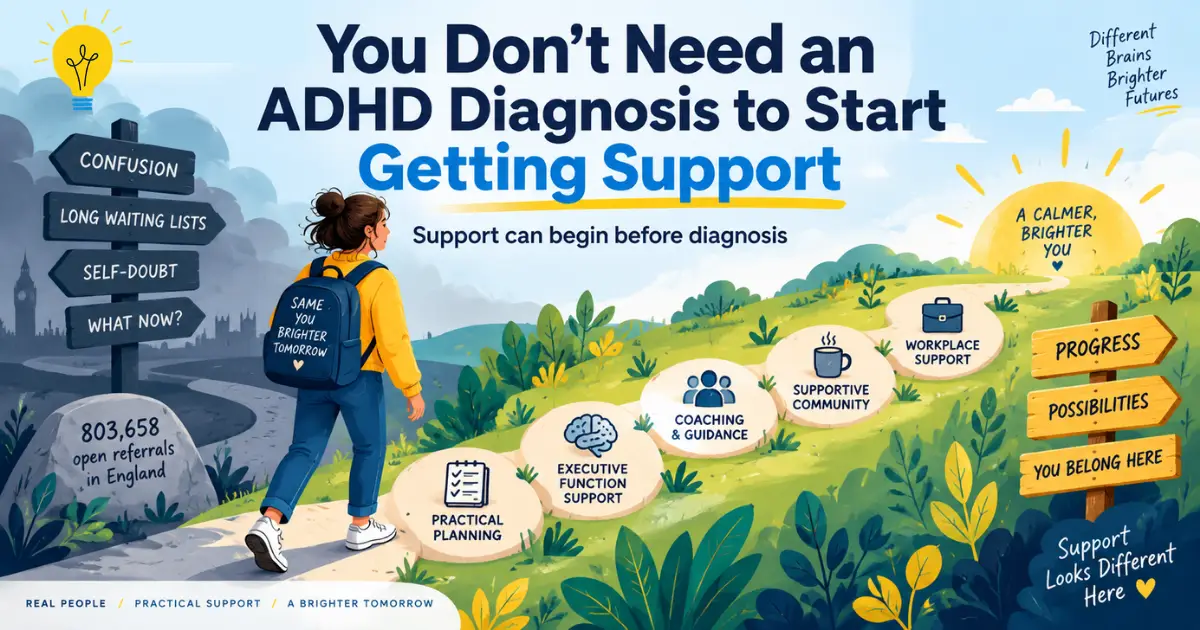
You do not need an ADHD diagnosis to start getting support.
A formal diagnosis matters. It can give you clarity and it is needed for clinical treatment such as ADHD medication. But a lot of practical support does not have to wait for an assessment.
You can work on problems with organisation, working memory, time, task initiation, overwhelm and executive function now. You can ask for support at work. You can find peer support. You can work with an ADHD coach.
And that matters when the wait for an assessment can take years.
In March 2026, NHS England recorded up to 803,658 open referrals that may have been for an ADHD assessment in England. Those are referrals rather than a count of unique people, and NHS England says the dataset is still developing.
I have looked at the scale of that problem in more detail in ADHD support in England: NHS waiting lists, funding and support before diagnosis.
Behind those referrals are people who sought an assessment because something was difficult enough for them to ask for help.
Some will eventually receive an ADHD diagnosis.
Some will not.
Some may fall just short of the full diagnostic criteria.
None of them should have to spend years doing nothing while they wait.
Do you need an ADHD diagnosis to get support?
No.
You do not need a formal ADHD diagnosis to start working on the difficulties that brought you to an assessment in the first place.
A diagnosis can be incredibly important. It can help somebody understand themselves, identify ADHD alongside other conditions and open access to clinical treatment.
But diagnosis and support are not the same thing.
If you cannot start tasks, lose track of time, forget appointments, become overwhelmed by ordinary demands or keep reaching the point of burnout at work, those problems exist whether or not somebody has completed an ADHD assessment.
You can start working on them now.
What ADHD support can you get without a diagnosis?
Quite a lot of practical support does not require a formal ADHD diagnosis.
- ADHD coaching focused on the difficulties you are actually experiencing.
- ADHD and neurodivergent peer-support groups.
- Help understanding executive function and how it affects everyday life.
- Practical strategies for working memory, time, organisation and task initiation.
- Changes to routines and your environment that reduce avoidable friction.
- Support with overwhelm, workload and burnout.
- Workplace conversations and reasonable adjustments based on what you are struggling with.
- Access to Work if a disability, illness or health condition affects your ability to work.
GOV.UK says you do not need to have a diagnosed condition to apply for Access to Work.
Acas also says a worker does not need a diagnosis to be considered disabled under the Equality Act 2010, and employers should support neurodivergent workers based on the difficulties they experience.
None of this requires you to claim that you have ADHD when you do not have a diagnosis.
You can work with the problems that are already there.

You can start with one problem
You do not need to know whether you want long-term coaching before you ask for help. A Brain Session is one focused hour to untangle one specific problem, decision or stuck point.
What can you do while waiting for an ADHD assessment?
For many people, the assessment becomes the thing they are holding onto.
It offers the possibility of an explanation for why life has always felt so difficult.
But waiting for that explanation does not mean you have to put everything else on hold.
You can learn about executive function now.
You can try different ways of working with your attention and memory now.
You can make time more visible. Reduce the number of things you are trying to remember. Change how tasks are presented. Look at what happens before you get stuck rather than only blaming yourself after it happens.
You can find other people with similar experiences.
You can ask for help at work.
You can start noticing which parts of your environment make life harder and which changes make things easier.
If you eventually receive a diagnosis, you may already understand yourself far better by the time that appointment arrives.
What if you do not get an ADHD diagnosis?
This is the part of the waiting-list conversation that gets much less attention.
You can wait years. Fill in forms. Answer questions. Try to remember what you were like as a child. Ask family members what they remember. Read about ADHD and recognise yourself in an uncomfortable amount of it.
Then the assessment finally happens.
And the clinician decides that you do not meet the full criteria for an ADHD diagnosis.
That matters clinically because diagnostic criteria have to distinguish between people who do and do not meet the requirements for a diagnosis.
It does not mean the difficulties that brought you to the assessment have disappeared.
You can still struggle with working memory, task initiation, organisation, time, attention and emotional regulation.
You can still recognise yourself strongly in ADHD.
What you do not have is the formal diagnosis.
That distinction matters, but it should not send you back to the beginning with the same problems and no idea what to do next.

Not sure what kind of support fits?
The ADHD Help Finder starts with what is difficult now, rather than asking you to know which service or label you need first.
Falling just below the ADHD threshold does not make the difficulties disappear
Human beings do not divide themselves neatly around diagnostic thresholds.
Imagine two people with almost identical difficulties.
Both struggle with organisation, attention, working memory, time and starting tasks. Both have spent years trying to understand why everyday life seems to require so much effort.
One meets the diagnostic criteria for ADHD.
The other falls just short.
It would make very little sense to decide that the first person deserves practical support while the second should simply go away and try harder.
The difference may matter for a formal diagnosis and access to medication. It does not make the second person’s difficulties any less real.
One point, one symptom or one clinical judgement at the edge of a threshold should not decide whether somebody gets help with difficulties that are already affecting their life.
Support should begin with what somebody is struggling with, not with whether they have crossed a diagnostic line.
What does need an ADHD diagnosis?
There are things you cannot access simply because you recognise ADHD traits in yourself.
ADHD medication is clinical treatment. It requires proper clinical assessment, prescribing and monitoring.
Some specialist services may also have their own eligibility criteria.
A formal assessment can identify ADHD, rule out other explanations and recognise conditions that may sit alongside it.
So the point is not that diagnosis does not matter.
It is that support and diagnosis are not the same thing.
We do not need to make somebody wait for clinical certainty before helping with every practical difficulty in their life.
Start with what you are struggling with, not the label
If you cannot start tasks, that is something you can work on.
If you constantly lose track of time, you can explore ways of making time more visible.
If you forget appointments, lose things or become overwhelmed by ordinary demands, you can find strategies that reduce those difficulties.
If work is becoming unmanageable, you can ask what changes would make it easier for you to do your job.
If the same problem keeps returning, ongoing ADHD coaching can give you space to understand the pattern rather than collecting another list of tips.
None of that requires you to pretend that you have a diagnosis you do not have.
It means recognising that the traits and difficulties that led you to seek an ADHD assessment are worth supporting in their own right.
You do not have to wait years to start living differently
Up to 803,658 open referrals that may have been for ADHD assessment is an extraordinary number.
Some of those people will eventually receive an ADHD diagnosis.
Some will not.
Some may fall just short of the threshold.
Every one of those referrals entered the system for a reason.
If ADHD seems to explain the way your brain works, you do not have to wait years before you start learning about it.
You can learn about executive function now. You can try different ways of working with your attention and memory now. You can find other people with similar experiences. You can ask for help. You can make changes that make daily life less difficult.
A future diagnosis may give you clarity and access to treatment.
Not receiving that diagnosis may leave you with more questions.
Neither outcome means you should spend the years in between doing nothing.
You can get support now.
Questions about getting ADHD support without a diagnosis
Can I get ADHD support without a diagnosis?
Yes. Practical support can focus on the difficulties you are experiencing, such as organisation, working memory, time, task initiation, overwhelm and problems at work, without requiring a formal ADHD diagnosis first.
Do I need an ADHD diagnosis for ADHD coaching?
Not with ADHDaptive. You can use coaching because something is difficult and you want to work on it. You do not need to prove that you have ADHD first.
Can I ask for support at work without an ADHD diagnosis?
Yes. Acas says a worker does not need a diagnosis to be considered disabled under the Equality Act 2010. Support should be discussed around the difficulties the person is experiencing.
Can I apply for Access to Work without an ADHD diagnosis?
Yes. GOV.UK says you do not need to have a diagnosed condition to apply. You do need a disability, illness or health condition that affects your work.
Can I get ADHD medication without a diagnosis?
Prescription ADHD medication is clinical treatment and requires assessment and prescribing by an appropriate clinician. Recognising ADHD traits in yourself is not the same as receiving a clinical diagnosis.