
There is something about the way ADHD support works in England that I keep coming back to, because the more I look at it, the less sense it makes.
We have hundreds of thousands of people waiting for ADHD assessment. Some are waiting years. NHS budgets are under serious pressure. More money is being spent trying to increase assessment capacity, including through private providers, because the NHS simply cannot meet the demand through existing services.
Yet for many people, meaningful support still sits at the far end of that process.
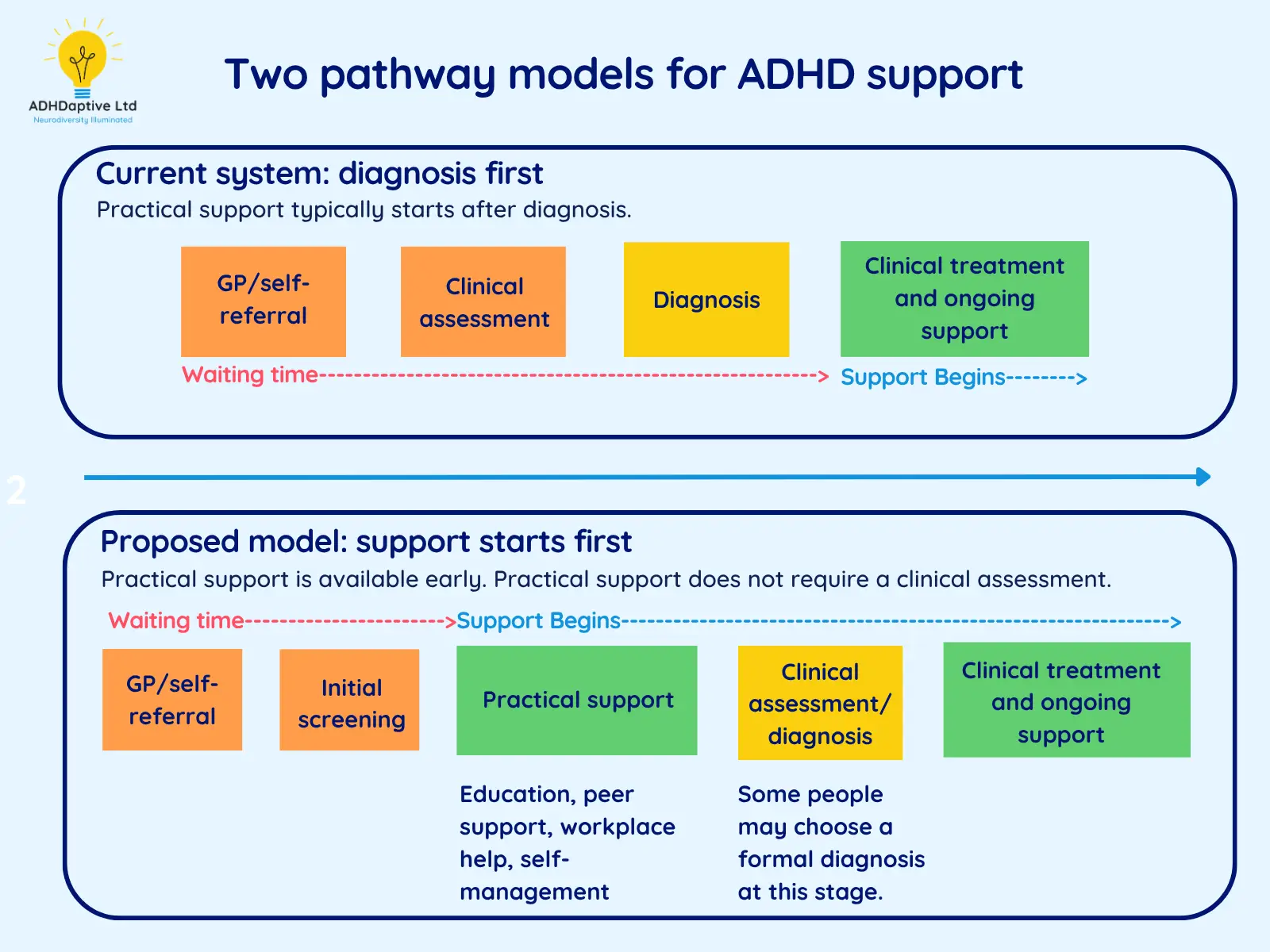
You get referred. You wait. You get assessed. You get diagnosed. Then, perhaps, somebody starts talking about what might actually help you live your life.
I understand why diagnosis matters. I have one myself. For some people it gives an explanation for decades of things that never quite made sense. It can lead to medication. It can identify other conditions. It can stop someone spending years believing they are simply lazy, useless or failing at things everybody else seems able to do.
But diagnosis and support are not the same thing.
And I am increasingly unconvinced that we should keep making one the gateway to the other.
The ADHD assessment waiting list in England is already enormous
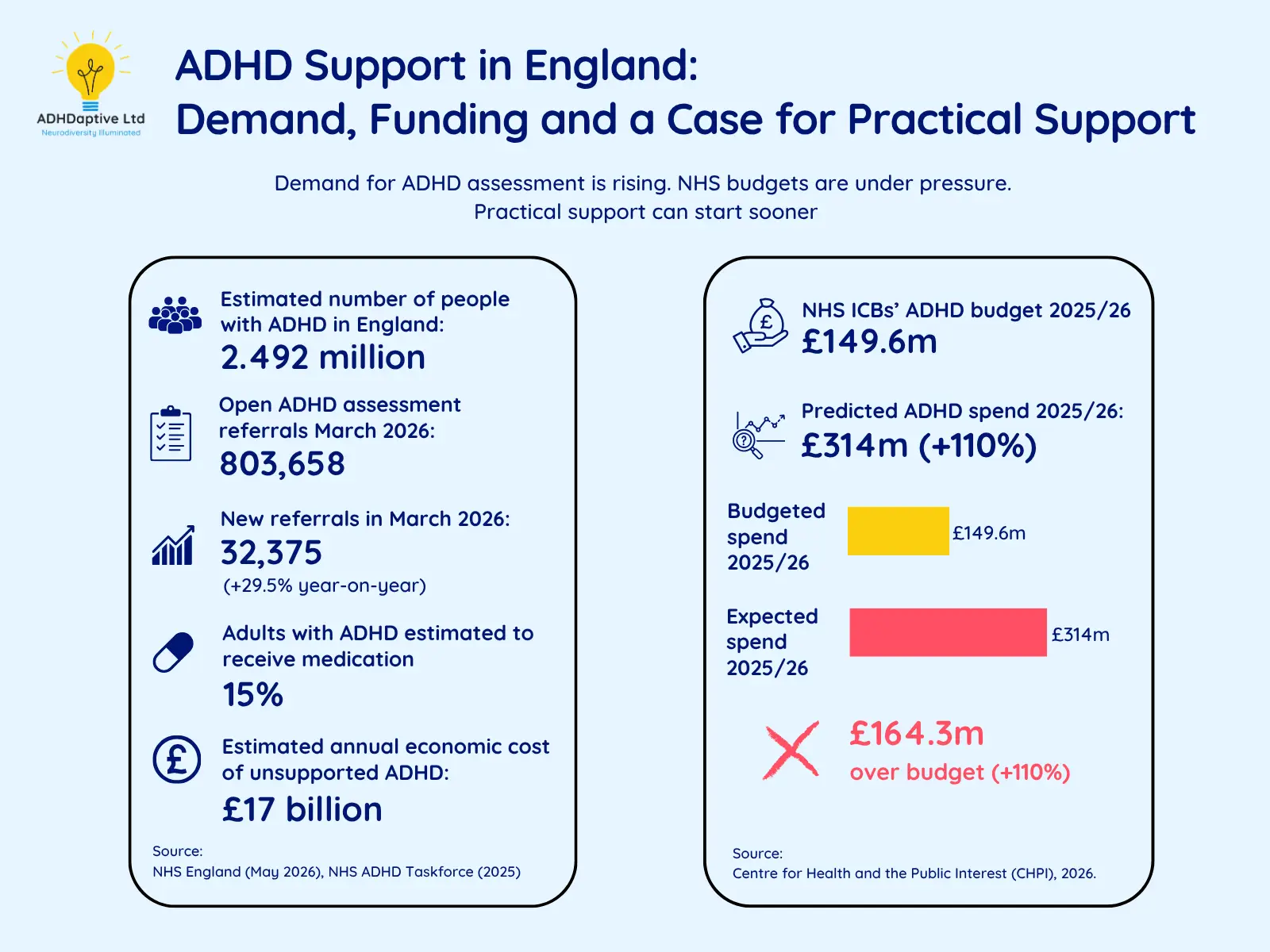
NHS England's May 2026 ADHD data estimated that around 2.492 million people in England have ADHD, including people who have never been diagnosed.
In March 2026 there were up to 803,658 open referrals which may have been for an ADHD assessment.
Another 32,375 referrals arrived during that month alone, around 29.5% more than in March the year before.
There are caveats around those referral figures because the NHS data is still developing and reporting has changed as more independent providers have been included. I don't think those caveats make the overall picture particularly difficult to see.
There are a lot of people trying to get into the system.
Why ADHD assessment referrals are rising
This matters because it is easy to look at rising referral numbers and assume ADHD itself must be becoming more common.
That is not what the evidence says.
The NHS ADHD Taskforce has said there is no evidence that the proportion of children meeting ADHD diagnostic criteria has increased over time. Adult prevalence estimates also remain broadly around the same range.
What has changed is recognition.
Adults who were missed as children are now coming forward. Women and girls who fitted the old stereotype badly are being recognised. People know more about ADHD. Clinicians know more about it. Social media has certainly played a part, sometimes helpfully and sometimes not.
There is something else buried in all of this which I think deserves far more attention.
The NHS ADHD Taskforce itself points to the perceived need for diagnosis to access support as one of the factors driving assessment demand.
That is hardly surprising.
If you build a system where people believe the only route to meaningful help is through diagnosis, people will queue for diagnosis.
Then we look at the queue and say we have a diagnosis capacity crisis.
Well, yes. We built one.
Why the NHS ADHD assessment pathway is under pressure
A proper ADHD assessment is clinical work and it should stay that way.
ADHD overlaps with autism, anxiety, depression, trauma, sleep problems and plenty of other things. A competent assessment needs to look at the whole person, not just count how many boxes somebody ticks on a questionnaire.
That takes skilled clinicians and time.
Which is exactly why I don't understand why we keep making that scarce resource the front door to support that does not need a psychiatrist, psychologist or specialist clinician.
You do not need a psychiatrist to help somebody understand executive function.
You do not need a psychiatrist to explain why they can run a complicated project at work but still forget to put the washing on.
You do not need a psychiatrist to help somebody identify where their routines fall apart, sort out task overload, work out what helps with planning, understand energy, talk through workplace adjustments or stop beating themselves up for using systems that were never designed for their brain in the first place.
Those things are support.
They are not diagnosis.
Yet people can wait years before anybody offers them much of either.
I find that very difficult to defend.
How much is the NHS spending on ADHD assessment?
In January 2026, the Centre for Health and the Public Interest published an analysis of NHS-funded ADHD services using Freedom of Information data from Integrated Care Boards in England.
For the 32 ICBs where the relevant figures were available, the combined ADHD assessment budget for 2025/26 was £149.6 million.
Expected spending was £314 million.
That is a projected overspend of £164.3 million.
£101 million of that projected overspend was attributed by the ICBs to Right to Choose providers.
Those numbers are large enough that they deserve more than a knee-jerk reaction.
An overspend is not proof that money has been wasted. It can mean the original budget was hopelessly unrealistic. It can mean demand was underestimated. It can mean local NHS capacity was nowhere near adequate. It can mean the purchasing model is poor. It can mean providers are charging too much. More than one of those things may be happening.
What it definitely tells us is that what the NHS planned to spend and what it now expects to spend are nowhere near each other.
That should make us ask what we are buying, why we are buying it that way and whether the same money could be doing more.
Is Right to Choose causing the ADHD assessment overspend?
There is an obvious temptation here to make private ADHD providers the villain.
I don't buy that as the whole explanation.
Right to Choose became popular because people were being told they could wait years for a local NHS assessment.
If you tell somebody they can wait three years or use a legal NHS-funded route that may get them seen much sooner, I am not going to blame them for choosing the second option.
The private sector did not invent the demand.
It stepped into a gap.
There are legitimate questions about costs, contracts, quality, regulation and what happens after diagnosis. Some providers assess people and then expect prescribing, titration or long-term monitoring to move back into NHS services that are already stretched. That can create another mess further down the line.
But closing or restricting Right to Choose without fixing the original capacity problem would just put people back into the queue they were trying to escape from.
That is not reform.
It is queue management.
£164.3 million is hard to picture
Big NHS numbers become meaningless very quickly.
£164.3 million sounds enormous, but most of us have no instinctive sense of what £164.3 million can actually buy.
So I did a deliberately crude comparison using something I know.
My six-session ADHDaptive coaching package costs £750.
At that price, £164.3 million is equivalent to roughly 219,000 six-session coaching packages.
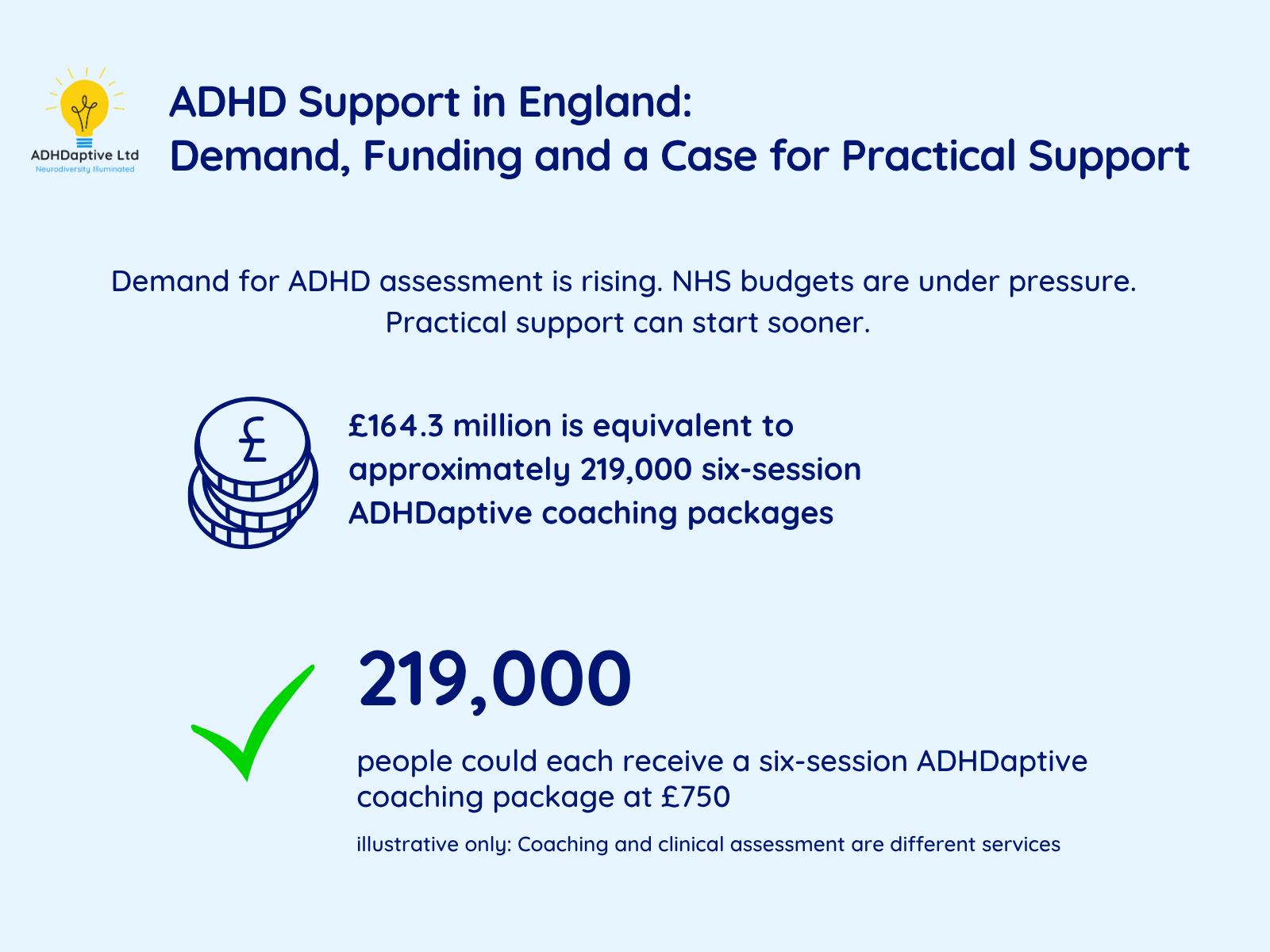
No, I am not suggesting the NHS should give ADHDaptive £164 million. I suspect that would create some paperwork.
And coaching is not a replacement for clinical assessment.
That comparison is deliberately illustrative because the services are completely different.
What it does show is scale.
We are already prepared to spend extraordinary amounts of money trying to get people through the diagnostic part of the pathway.
At the same time, relatively low-cost practical support can remain difficult to access before diagnosis and patchy afterwards.
That feels wrong to me.
The NHS ADHD Taskforce has estimated the annual economic cost associated with unsupported ADHD at around £17 billion.
If unsupported ADHD is costing anything remotely close to that, then support should not be treated as the optional extra at the end of the expensive bit.
Diagnosis still matters
I don't want this argument twisted into “we don't need diagnosis”.
We do.
Some people want diagnostic certainty and there is nothing trivial about that.
Some people need medication.
Some people need a proper differential diagnosis because what looks like ADHD may be something else, or ADHD may be sitting alongside something else that also needs attention.
Some people are struggling badly enough that they need clinical help quickly, not a coaching conversation and a worksheet.
A support-first model should never become an excuse for making diagnosis harder to access.
It should do something much simpler.
It should stop us pretending everybody needs to finish the diagnostic process before anything useful can begin.
The NHS ADHD Taskforce already supports earlier help
What surprised me when I started looking properly at this is that this isn't some wild alternative model sitting outside NHS thinking.
The NHS ADHD Taskforce has already said support should begin early, should be based on need and should not depend entirely on waiting for a clinical diagnosis.
It has described the current specialist single-diagnosis model as unsustainable and talked about stepped care, more support through community and primary care services and earlier access to non-pharmacological help.
The Health and Social Care Committee has also argued for support and diagnostic services to be separated, particularly in children's autism and ADHD pathways.
So we are not really arguing anymore about whether somebody can be helped before diagnosis.
The interesting question is why we still organise so much of the system as though they cannot.
A support-first ADHD pathway
I would split the pathway.
Not into two completely separate systems, but into two routes that can run alongside each other.
Someone referred with possible ADHD could have an early screening and needs assessment. That screening would not diagnose ADHD. Its job would be to work out what the person is struggling with, whether there are immediate risks, whether they clearly need clinical assessment and what support could start now.
From there:
- People who need urgent or complex clinical assessment could move quickly into the clinical pathway.
- People who want formal diagnosis could remain on the diagnostic pathway while receiving support at the same time.
- People who need medication would still need proper clinical assessment, diagnosis and prescribing.
- People could access practical help with executive function, routines, work, education, self-management and everyday functioning without waiting years for a diagnostic appointment.
- Some people may find that practical support addresses much of what brought them to the service in the first place.
- Nobody would be told that support replaces diagnosis if diagnosis is what they need or want.
Screening is not ADHD diagnosis
The proposed model is not “do a quick screening and call it ADHD”.
That would be dreadful.
Screening is not diagnosis.
The point is that you do not need to diagnose somebody before helping with problems that are already sitting in front of you. That is the kind of practical work I do through ADHDaptive and my ADHD coaching for adults.
If someone cannot organise their workload, help with that.
If they are overwhelmed by competing demands, help with that.
If they are repeatedly burning out because every system they use relies on memory and sustained attention, help with that.
If they are struggling with sleep, routines, planning or work adjustments, there is useful work that can begin while the clinical questions are still being answered.
We seem strangely reluctant to do that because the system likes categories.
People's lives are less tidy.
Why people join the ADHD diagnostic queue for different reasons
Someone asking for an ADHD assessment may be saying any number of things.
They might want medication.
They might want an explanation.
They might be desperate for help at work.
They might need support at university.
They might have spent twenty years wondering why ordinary life feels harder than it apparently should.
They might simply want somebody to believe them.
At the moment, a lot of those needs get funnelled into the same route.
Assessment.
Diagnosis.
Then we see what happens.
That is an astonishingly expensive way to answer a set of very different questions.
A support-first approach could separate those needs much earlier.
It would not make the clinical backlog vanish. I don't think anything sensible can promise that.
But it might mean the people waiting for specialist clinical work are more likely to be the people who actually need specialist clinical work.
And everybody else could stop being told that waiting counts as care.
What happens after an ADHD diagnosis?
There is another reason I don't like the diagnosis-first model.
Getting diagnosed is often treated as though somebody has reached the finish line.
For many people it is the beginning of another queue.
Medication titration can be difficult to access. Shared care can fall apart. GPs may not accept prescribing responsibility. Post-diagnostic support varies wildly.
So somebody can spend years waiting for an assessment, finally receive an answer and then discover the next bit of the system is missing.
That is not a pathway.
It is a sequence of hand-offs and gaps.
If we are serious about ADHD care, the question cannot just be how quickly we diagnose people.
It has to be what happens to them before, during and after that diagnosis.
We need to spend money on the problem we are actually trying to solve
England needs more ADHD clinical capacity. I don't see a credible argument against that.
People should not wait years for assessment.
People who want medication should not sit indefinitely in limbo.
Clinical standards should not be diluted just to clear a backlog.
Public money going to private providers should be properly scrutinised.
But I also think we are making a basic mistake if we keep pouring money into the diagnostic bottleneck while treating practical support as something to sort out later.
The question is not only:
How do we assess 803,658 people faster?
The more useful question may be:
Why are 803,658 people waiting for an assessment before we help them with anything?
Those are very different problems.
And they lead to very different ways of spending money.
What a support-first ADHD pathway could look like
I would:
- Keep proper clinical ADHD assessment for people who need or want it.
- Protect access to medication and specialist care.
- Screen people early for need, risk and complexity.
- Start appropriate practical support within weeks rather than years.
- Let support continue while somebody waits for formal diagnosis.
- Stop making diagnosis a condition for help that never needed diagnosis in the first place.
- Make it easy for people to move into clinical services when their needs change.
That isn't replacing healthcare with ADHD coaching.
It is using expensive clinical care for the things that actually require clinical care.
And using other forms of support for the things that don't.
Frankly, I find it odd that this needs saying.
Why ADHD support should not wait for diagnosis
The current numbers are uncomfortable.
Up to 803,658 open referrals.
New referrals still rising.
Assessment spending running far above budget.
An estimated economic cost of unsupported ADHD measured in billions.
And behind all of that are people who are still trying to work, study, parent, hold relationships together and manage ordinary life while waiting for somebody to decide what label applies.
We need more diagnostic capacity.
We also need to stop treating diagnosis as the moment at which support is finally allowed to begin.
If we can help somebody now, I think we should. If you are waiting for assessment now, the ADHD Help Finder sets out practical support options that do not require you to put life on hold.
Waiting three years to confirm why somebody is struggling should not mean waiting three years to help them struggle less.
That, for me, is the bit of the current system that no longer makes sense.
Sources and data
- NHS England Digital: ADHD Management Information, May 2026
- NHS England: Independent ADHD Taskforce reports
- Centre for Health and the Public Interest: Market failure, January 2026
- Health and Social Care Committee: autism and ADHD diagnostic pathways for children and young people
The national ADHD referral data is published as management information and NHS England cautions that the collection is still developing. The CHPI spending figures cover the 32 Integrated Care Boards for which the relevant data was available.