The Great ADHD Myth? What Channel 4 Got Right and Wrong
I watched Channel 4’s The Great ADHD Myth? expecting to disagree with every minute of it.
Strangely, I agree with its broadest message.
I have long thought that ADHD may be better understood as part of normal human variation rather than evidence of a disordered or defective brain.
Human beings vary. We vary in height, temperament, energy, sociability, memory, sensitivity and how we direct our attention. There is no sensible reason to imagine that every healthy brain should concentrate, organise itself, regulate emotion or respond to stimulation in one standard way.
Society has still built schools and workplaces around a fairly narrow idea of how people should think and behave.
Sit still. Concentrate on demand. Ignore everything around you. Remember instructions. Start when told. Stop when told. Work at a steady pace. Stay organised. Control your emotions. Look interested, including when you are bored senseless.
People who fall outside that range are expected to change themselves to fit.
Much of the disability associated with ADHD appears when a person collides with an environment that was never designed for them. Change that environment and some of the disability reduces. Sometimes dramatically.
That is the part of the programme I agreed with.
My agreement ended when it tried to prove its case.
What is Channel 4’s The Great ADHD Myth? arguing?
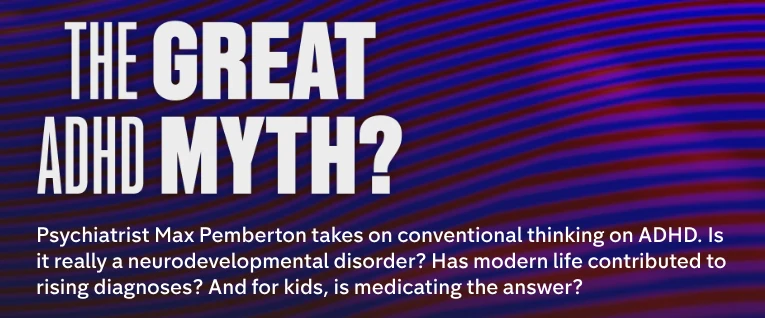
The programme, presented by psychiatrist Max Pemberton, asks whether ADHD is a genuine neurodevelopmental condition or a collection of ordinary behaviours turned into a medical diagnosis.
That is a valid question to explore. Diagnostic categories are created by people. The boundary between a difference and a disorder involves judgement about distress, impairment and what society expects from us.
The programme could have examined that boundary with care. It could have asked how much difficulty comes from the person, how much comes from the environment and how those things interact. It could have questioned poor assessments, commercial interests and careless prescribing without dismissing everyone whose life has been changed by diagnosis or medication.
It chose a much easier story.
ADHD became an invented label. Medication became behavioural control. Schools became the real disorder. Screens, food and modern life became convenient explanations.
There are fragments of truth in that story. The finished argument is still a mess.
Mason’s ADHD medication experiment proved very little
The programme follows Mason, a ten-year-old boy diagnosed with ADHD and taking lisdexamfetamine.
His medication helps him concentrate. Before treatment he was scoring two or three out of 60 in schoolwork. On medication, he reached the expected level for his age.
Mason also says the medicine takes away his “fun-ness”. His mum describes him as quieter and less like himself. That matters. A child’s educational performance should never silence what the child says about their own emotional life.
The programme then takes Mason off medication for six weeks.
At the same time:
- His screens and gaming are removed.
- His diet changes and processed food and sweets are removed.
- He starts taking nutritional supplements.
- He does yoga, spends more time outside and exercises more.
- The family spends more time together.
- His routine changes.
- He receives close attention from a television production.
That is not a meaningful experiment. It is a pile of changes happening to one child at the same time.
When Mason’s behaviour changes, nobody can tell which change caused it. We cannot know whether it came from stopping medication, reducing screens, increased exercise, more family attention, the novelty of the routine or some mixture of them.
The programme still presents his progress as evidence for its argument.
Mason becomes happier, warmer and more sociable. He appears to enjoy family life more. Those are good outcomes and they deserve weight.
His concentration at school then deteriorates. He becomes fidgety, disruptive and frustrated by work he could previously complete. His mum is told that he looks back at his earlier work, knows he used to be able to do it and becomes upset.
That part is hurried past because it complicates the story.
What the programme actually shows is a child gaining something and losing something. His personality and relationships appear to improve. His ability to regulate attention and complete schoolwork gets worse.
That called for curiosity.
Was his dose too high? Would a lower dose preserve the benefit without flattening his personality? Would another medicine suit him better? Could the school change his work, movement breaks or classroom environment? Could medication and wider changes work together? What did Mason value most?
The programme had already chosen its answer. The school was wrong and the medication was suppressing the real Mason.
Perhaps the school was wrong. That still does not make his struggle imaginary.
Max Pemberton’s private ADHD diagnosis raises questions
Pemberton pays £1,200 for a private ADHD assessment and receives a diagnosis.
He then says he does not believe he has ADHD and experiences no disability in any part of his life.
That raises a serious question about the assessment. NICE says ADHD symptoms must cause at least moderate impairment, occur in at least two important settings and form part of a full clinical, developmental and psychosocial assessment. A diagnosis should not be made from a rating scale alone.
Either the assessment was poor, Pemberton gave the clinician a different account from the one he gave viewers, or relevant evidence was cut from the programme.
We never find out which.
He takes one dose of lisdexamfetamine. He feels slowed down, less sociable and less like himself. He then uses that experience to interpret what medication does to Mason.
It proves how one tablet affected Max Pemberton on one day.
Pemberton believes he does not have ADHD. His response cannot tell us what a properly adjusted dose does for a person who experiences severe impairment. It cannot tell us whether Mason’s dose was right. It cannot tell us how benefits and unwanted effects change during titration or longer treatment.
It makes good television. It makes poor evidence.
Why no ADHD brain scan does not disprove ADHD
The programme makes much of the fact that a brain scan cannot identify an individual with ADHD.
That fact is correct.
Research finds small average differences between groups of people with and without an ADHD diagnosis. There is considerable overlap, so those differences cannot diagnose an individual. The World Federation of ADHD consensus review states this openly.
The programme turns that limitation into a far larger claim. It suggests that the lack of an individual biological marker means there is no evidence for a neurodevelopmental condition.
That conclusion does not follow.
ADHD was never diagnosed through an MRI scanner. Its evidence base includes developmental history, family and genetic patterns, behaviour across settings, long-term outcomes, treatment response and group-level findings in brain structure and function.
“ADHD brains are wired differently” is often used far too casually. It can suggest a clear and universal physical distinction that science cannot show in each person. Challenging that phrase is fair.
Using its weakness to dismiss the wider evidence is not.
ADHD medication is not “slow-release cocaine”
One contributor describes ADHD medicines as working like “slow-release cocaine”.
That is simply false.
ADHD medicines include stimulants and non-stimulants with different active substances, delivery methods and risk profiles. Lisdexamfetamine, the medicine used by Mason and Pemberton, is a pharmacologically inactive prodrug converted in the blood into dexamfetamine. Its formulation and pharmacology are described in the official Elvanse prescribing information.
Calling the entire category “slow-release cocaine” is sensationalism designed to frighten viewers.
There are serious questions to ask about ADHD medication. Side effects can include appetite changes, sleep problems, increased heart rate, anxiety, irritability and emotional blunting. Children need careful monitoring. Their own experience of treatment must carry weight. Prescribers should review whether the medicine is helping, whether the dose is right and whether the unwanted effects outweigh the benefits.
NICE says medication for children aged five and over should be offered only when significant impairment continues after environmental changes have been tried and reviewed. Treatment should include the child or young person’s views and a full baseline assessment. The NICE explanation is quite explicit.
Real criticism does not need a cocaine comparison.
Common ADHD traits are not the same as an ADHD diagnosis
Pemberton reads several ADHD criteria from the DSM and points out that almost everyone fidgets, dislikes waiting or struggles to concentrate sometimes.
Yes. They do.
The same applies to sadness, anxiety, pain, tiredness and memory problems. Human experiences become clinically significant through their frequency, persistence, severity and effect on life.
The diagnostic question is not whether somebody has ever lost their keys or interrupted a conversation. It asks whether a persistent pattern began during development, appears across different settings and causes meaningful impairment.
There is room to question where that threshold is drawn. There is room to criticise clinicians who diagnose without establishing impairment. There is room to ask whether rising demand has encouraged weak assessments.
Removing impairment from the description and laughing at how ordinary the remaining traits sound proves very little.
What The Great ADHD Myth? gets right

Schools should allow more movement, creativity and different ways of learning.
Workplaces should stop treating one style of attention and organisation as morally superior.
People should have more control over what support and treatment they use.
Children should not be medicated merely because adults find them inconvenient.
Medication should never replace suitable teaching, family support, sleep, exercise, decent food, time outside or an environment that fits the person.
We should stop treating difference as defect.
Current NICE guidance already recognises that environmental changes can reduce impairment. It gives examples including shorter periods of focus, movement breaks, reduced distraction, written instructions and changes to lighting, noise and seating. NICE describes those changes here.
The cultural ambition is sound. The programme acts as if we must deny ADHD’s developmental basis to pursue it.
We do not.
Why removing ADHD diagnosis would remove support
Changing how society understands attention, productivity, learning and behaviour is a huge cultural task.
It will take years. Probably generations.
Diagnosis currently gives many people language for experiences they could never explain. It brings recognition. It can open routes to treatment, medication, support and reasonable adjustments. It can replace decades of shame with an account that finally makes sense.
The system is imperfect. Access is unequal. Some assessments are poor. Some treatment is poorly monitored. A medical label can carry stigma and can make ordinary difference sound defective.
Those are reasons to improve the system while changing the culture around it.
Abolishing the label today would not create inclusive schools tomorrow. It would leave people facing the same demands with fewer ways to explain their needs and fewer routes to help.
Some people would gladly use less medication in a world which fitted them better. Others experience difficulties that follow them home, into relationships, driving, money, self-care and the quietest room imaginable. They may still choose medication, ADHD coaching or clinical support.
That choice belongs to them.
You cannot pull away the safety net while hoping society will become kinder later.
Change society first. Then perhaps fewer people will need the label to survive it.
Channel 4, you need to try harder.
Yes, the irony is deliberate.
FAQs about The Great ADHD Myth?
What is The Great ADHD Myth? about?
Channel 4’s The Great ADHD Myth? questions whether ADHD is a genuine neurodevelopmental condition, whether ordinary behaviours are being medicalised and whether schools, screens, diet and modern life contribute to rising diagnoses.
Does the programme prove that ADHD medication is unnecessary?
No. Its main experiment changes medication, screens, food, supplements, exercise, outdoor activity, family time and routine at once for one child. That cannot show which change caused each outcome.
Can a brain scan diagnose ADHD?
No. Research finds small average differences between groups, with too much overlap to diagnose an individual. That limitation does not show that ADHD has no developmental or biological basis.
Is ADHD medication slow-release cocaine?
No. ADHD treatments include several stimulants and non-stimulants. Lisdexamfetamine is an inactive prodrug converted in the blood into dexamfetamine. Calling the whole category slow-release cocaine is inaccurate.
Can ADHD be real while schools and workplaces still cause disability?
Yes. A person’s difficulties can arise through an interaction between their traits and the demands around them. Changing an environment can reduce impairment without proving that the underlying pattern is imaginary.