
How to Be Normal With ADHD? There Is a Better Question

How do I become normal with ADHD? How do I stop being different? Why can’t I just do the things everyone else seems able to do?
They are painful questions, usually asked after years of desperately trying to “be better”, yet still feeling as though you are failing or broken.
The problem is that “How can I be normal?” assumes normal is a real, fixed thing you can put your finger on, and sends you looking for the wrong solution.
You may not need to become more normal. You may need to understand what keeps happening, stop treating every difficulty as a character flaw, and build ways of living that work with your brain rather than against it.
A better question is:
How can I build a life that works with my ADHD brain and feel accepted without pretending?
What does normal actually mean?
Normal usually means behaving in the way other people expect in a particular place. Arriving at the expected time. Remembering messages. Keeping your space tidy. Starting a task without needing an hour to circle it first. Staying calm when plans change. Looking as though you have everything under control.
None of that is a neutral measure of your worth. It is a collection of expectations, many of which were built around people whose attention, memory, energy and sensory needs work differently from yours.
ADHD can also be inconsistent, which makes the judgement sharper. If something interests you, you may be able to do it faster and better than many other people. But if it does not interest you, or you are simply not feeling it that day, it may not happen at all.
Other people can mistake that inconsistency for choice. You did it yesterday, so why not today? You can focus on something you enjoy, so why not this report? You remembered a detail from ten years ago, so why did you forget the appointment?
From the inside, the difference can be obvious. From the outside, it may look like carelessness, laziness or a refusal to try.
Trying to look normal can become a full-time job
You may learn to hide the things that give you away. You rehearse conversations, copy how other people organise themselves, stay late to finish work, set several alarms, check every message repeatedly and laugh off mistakes before anyone else can comment on them.
You may force yourself through noisy rooms, confusing instructions and tasks that feel impossible to start. You keep smiling. You try not to interrupt. You pretend you are following a conversation after your attention has already wandered away.
This is masking. It can help you get through situations, but it carries a cost. Looking calm is not the same as feeling calm. Appearing organised does not mean the system is easy to maintain. Getting the work done says nothing about the amount of strain behind it.
Perhaps you have been told you are making excuses when you try to explain that strain. After hearing it enough times, you may start accusing yourself before anyone else gets the chance.
The result can be exhaustion, shame and a growing belief that everybody else received a basic set of instructions for life that somehow missed you.
Other people see the outcome, not what happened inside
People see the late arrival, not the time blindness and the frantic search for your keys. They see the missed deadline, not the hours spent unable to work out where to begin. They see the forgotten message, not the interruption that wiped it from working memory.
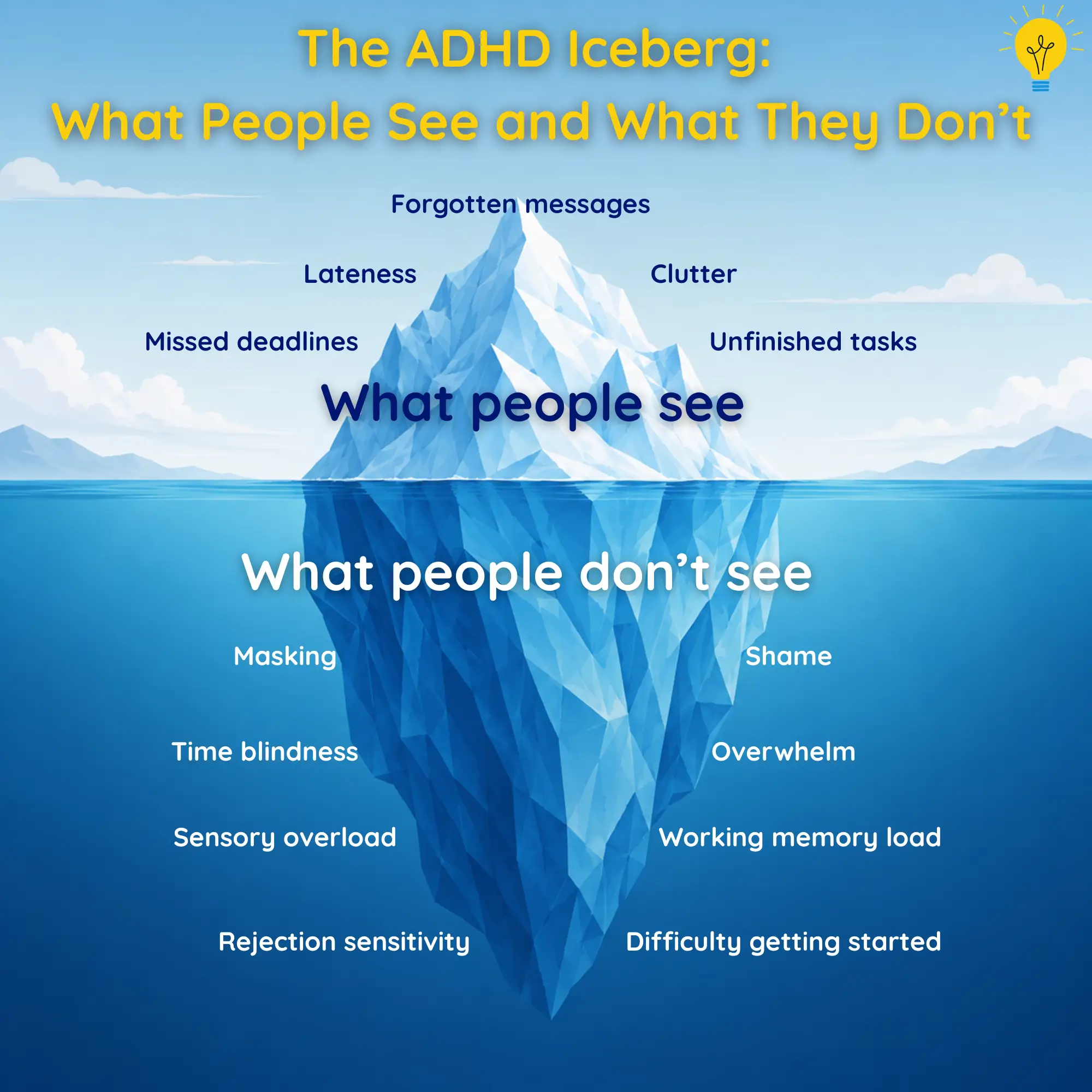
They see clutter, unfinished tasks or a strong emotional reaction. They do not automatically see overwhelm, sensory overload, rejection sensitivity, perfectionism, masking or burnout.
A lot of ADHD advice focuses on visible behaviour and consequences.
Set another reminder. Write a better list. Try harder. Be more disciplined. Stop leaving things until the last minute.
Sometimes those suggestions help. Quite often, they add another failed system to the pile because they do not address the reason the problem keeps happening.
Explaining the reason is not the same as making excuses. It gives you a chance to choose a response that might work. You cannot solve time blindness, sensory overload and unclear instructions in the same way, just because they all ended with a missed deadline.
Start recognising your patterns
This is where an ADHD brain can sometimes be useful. You may already be good at noticing connections, repeated problems and small details that other people miss. Turn that curiosity towards yourself. Look closely at the times things keep going wrong and try to work out what is happening underneath.
Ask yourself:
- What was I trying to do?
- At what point did I get stuck or wander away?
- Was the task unclear, boring, too large, emotionally loaded or full of hidden steps?
- Was I tired, hungry, overstimulated or already carrying too much?
- What was different on the occasions when it went more easily?
The aim is not to analyse yourself into perfection. It is to gather enough useful information to stop repeating solutions that do not fit the problem.
Some people will understand, and some will not. Self-understanding cannot make a manager, family member or workplace suddenly become supportive. But it can help you recognise what you need, explain it more clearly and decide where your energy is worth spending.
The better question
“How can I be normal?” puts the whole burden on you. It asks how you can hide the difference, tolerate more discomfort and produce the expected result without anybody noticing the effort.
“How can I build a life that works with my ADHD brain?” leads somewhere more useful.
It allows you to ask what support, structure, environment and expectations make things more manageable. It leaves room for the fact that some things will remain difficult. It also gives you permission to stop spending every ounce of energy trying to look unaffected.
This does not mean giving up, lowering every expectation or refusing responsibility. It means working with accurate information. A solution built for the real problem has a better chance than one built around how you think you should behave.
Small changes can make a real difference
The useful change is often smaller and more specific than a complete new productivity system.
- Keep keys in one visible place beside the door.
- Ask for instructions in writing rather than trusting working memory.
- Use body doubling for a task that repeatedly refuses to start.
- Break the first step down until it feels almost too small to count.
- Add travel time before the time you think you need.
- Reduce noise, light or interruptions before blaming your concentration.
- Keep a few simple meals available for days when cooking has too many steps.
This is not about collecting random ADHD hacks. The usefulness comes from understanding what keeps catching you and choosing a response that matches the actual problem.
A strategy that helps one person may irritate another. You are allowed to test things, keep what works and discard what does not.
You are allowed to ask for help
Support does not make your effort less real. Written instructions, quieter working space, flexible scheduling, reminders from another person, medication, coaching or help with planning are not cheating. They are ways of reducing barriers.
You may still meet people who call this making excuses. Their opinion does not turn a genuine difficulty into a moral failure.
You are responsible for your actions, but responsibility does not mean pretending the cause is irrelevant. Understanding why something happened is often the first sensible step towards changing what happens next.
You do not need to remove your personality
There is a risk that “managing ADHD” becomes another instruction to make yourself quieter, tidier, easier and less noticeable.
You do not have to remove your curiosity, humour, intensity, creativity or enthusiasm to deserve acceptance. You can work on the things that hurt you without treating your whole personality as the problem.
ADHD can be disabling and exhausting. Pretending every trait is a gift helps nobody. But neither does treating every difference as a defect.
The aim is not a polished version of somebody else. It is a life in which you can use what works in your brain and get support for what does not.
How ADHD coaching can help
Coaching gives you time to look at one pattern closely, work out what is underneath it and test changes in real life. It can also provide structure and accountability without turning every session into another lecture about what you should have done.
Coaching will not remove ADHD or make every difficult situation disappear. It can help you understand the patterns, test practical changes and stop wasting energy on solutions that were never suited to you.
My work is practical and shaped around what is actually happening in your life. You can read more about ADHD coaching for adults in Newcastle, the North East and online across the UK.
You were never failing at being normal
You were trying to meet expectations without always having the support, explanation or conditions you needed.
There may still be things you want to change. There may be consequences to repair and skills to build. None of that requires you to begin from the belief that you are broken.
You do not need to become normal. You need enough understanding, support and permission to build around the reality of how your brain works.
That is a better question, and a much more useful place to begin.