
ADHD, Autism and Gaslighting at Work
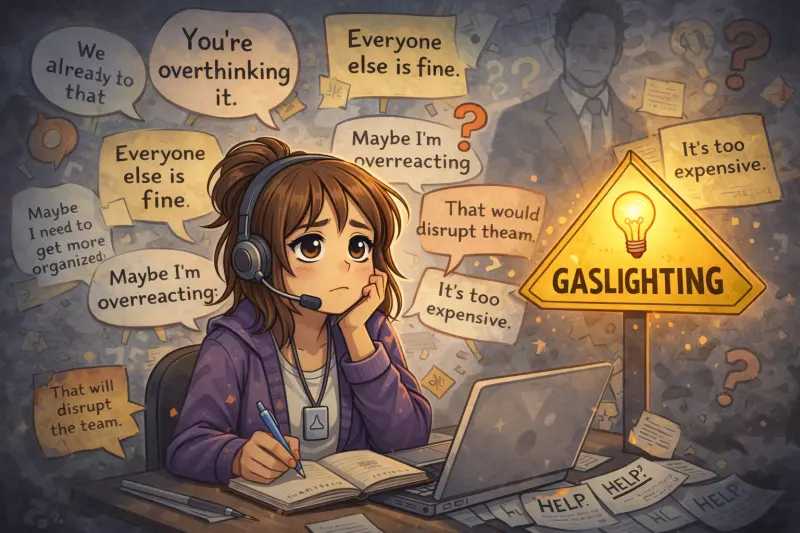
What gaslighting looks like at work
I think we have all been there. We ask for something small, something not too outrageous, just a little something that would help us function.
Often this comes back as an outright no, with a bit of politeness. You hear things like:
- “We already do that”
- “You are overthinking it”
- “Everyone else manages”
There is nothing there you can really argue about directly, so it sounds fair enough. But the result is that you are left feeling unsure of yourself and uneasy.
What has happened, possibly unknowingly, is very subtle. What you have said has been turned on its head. Your needs, difficulties, and experience have become wants and misunderstandings. Even worse, you have become unreliable. You have become the problem.
This is gaslighting at work.
As a result, you do not ask again. You struggle on in silence and try to adapt as best you can.

When reasonable adjustments don’t feel reasonable
What makes this worse is that the system is supposed to be supporting you. The organisation says it embraces neurodiversity, and there are policies and processes to back it up. They say all of the right words, and all those boxes are ticked.
The trouble is that all too often:
- Adjustments are treated as optional.
- Clarity is treated as a favour.
- Consistency isn’t seen as realistic.
This means that when you ask for help, the gaps are your fault, not the environment.
This is gaslighting.
You are told support is there. You ask for it. You are told you do not need it.
So you stop asking.
If organisations really do want to take neurodiversity seriously, it has to start with this, not with away days, training sessions, or workshops. People need to feel they can ask for help and still trust their own experiences afterwards.
I am not saying that reasonable adjustments are gaslighting. The truth is worse than that. Support exists on paper, but the moment you ask for it, you end up doubting yourself.
Why ADHD and autism make this worse
The psychological issues go way beyond the actual rejection. Conversations like this mount up, and you start changing yourself. You start masking.
Before you even speak, you are thinking about what you will say and editing your own words. You try to think of a more reasonable way to ask. You water down your words, and in your head, you have shrunk the problem. Eventually, you just do not bother asking, as you know what the answer will be.
People with ADHD and autism hear these negative messages virtually every day and have been hearing them since they were young enough to understand the words. They have come to believe them, and this is only further reinforcement.
You misunderstood, you missed something, you are overthinking it, or you have taken it the wrong way.
How it shows up in real conversations
I hear about this almost every day, but people do not say, “I am being gaslit”. Their actual words are more like:
- “Maybe I am expecting too much”
- “Maybe I need to be better organised”
- “Maybe I need to try harder”
- “Maybe I am just stupid”
That is the bit that really gets me. The problem often started outside them, but somehow it has ended up living inside them.
Why you start doubting yourself
When you dig into what is actually going on, it often turns out to be something very ordinary and very avoidable.
- The deadline changed.
- The instructions were unclear.
- Someone changed their mind.
But instead of that being acknowledged, the neurodivergent person ends up carrying the uncertainty, the blame, and the shame.
Over time, this does real damage. Not just to confidence, but to trust in your own judgement.

What helps
You may not be able to change the whole environment overnight, but you can steady yourself inside it.
Writing things down helps. Following up conversations in email helps. Naming patterns helps. So does talking to someone outside the immediate situation who can reflect things back clearly.
Sometimes the biggest shift is simply realising that you are not imagining it, not too sensitive, and not failing because you could not adapt to something unreasonable.
If you want extra support at work, check out our Access to Work funding guide.
Want more like this? For the latest articles, reflections, and practical support, head over to the blog home.
View Blog Home