
What Executive Dysfunction Really Feels Like (And How to Cope)

Executive dysfunction is not laziness
You're not being lazy.
You're not ignoring your responsibilities.
You're stuck in a way most people can't see.

You're looking at a simple task. Something that should take two minutes. Reply to a text. Put on a load of washing. Fill in a form.
You know it is not hard. You want to do it.
But your brain does not respond. You freeze. You stall. You scroll. Or stare. Or cry. Or dissociate.
Then the guilt starts. And that makes it even harder.
If this feels familiar, you might also find ADHD task initiation support useful. It is the same stuck feeling, looked at from a practical coaching angle.

What is executive dysfunction?
Executive dysfunction is a breakdown in the brain’s self-management system.
It affects the skills most people rely on without thinking too much about them.
- Starting a task
- Planning steps
- Switching focus
- Managing time
- Regulating emotions
- Remembering what you were doing mid-task
- Finishing something without drifting off or shutting down
It is not a motivation problem. It is a neurological block.
That matters, because the wrong explanation leads to the wrong support. If you call it laziness, you reach for shame. If you call it executive dysfunction, you can start looking for support that actually fits.
What it looks like from the outside
To other people, executive dysfunction might look like:
- Missed deadlines
- A chaotic living space
- Poor timekeeping
- Forgetting important things
- Procrastinating endlessly
It can come across as careless or unreliable. But they do not see what is happening inside.
What it feels like from the inside
- You think about the task all day, but never start.
- You keep switching tabs but cannot finish anything.
- Your brain goes quiet. Or frantic. Or both.
- Everything feels harder than it should be.
- One email can ruin your entire afternoon.
You might get stuck choosing between two small tasks and end up doing neither.
You want to move. But you cannot.
It is not about willpower
This is not something you can fix by trying harder. You are not weak or disorganised. Your brain is asking for a different route into the task.
Sometimes you finally start a task, then freeze halfway through. Or finish it, but forget to send it. Or do something else entirely without realising why.
If you have ever sat on your bed for three hours thinking about brushing your teeth, this is what we are talking about.
It can also sit very close to task paralysis, overwhelm, burnout and shame. That is why pushing harder often makes things worse.
Real-life examples of executive dysfunction
- You draft an email ten times in your head, but still do not hit send.
- You walk into a room and forget why you are there.
- You write a to-do list, then avoid it.
- You load the dishwasher but leave it open for hours.
- You cannot start work, even though you are already late.
- You keep rereading the same instruction because your brain will not hold it still.
- You avoid one small admin task until it becomes a much bigger problem.
It is exhausting. Not just physically, but mentally and emotionally too.
Strategies that can actually help
There is no one-size-fits-all answer, but there are ways to reduce the friction.
Here are some that work for me and for many of the people I coach.

Sit next to someone for body doubling
You do not need to talk. Just be in the same room. You each do your own thing, but having someone there helps you get started. It is one of the simplest ways to break inertia.
Use starter steps
Forget the whole task. Just do the very first action.
- Touch the object you need.
- Stand up.
- Open the document.
- Say what you are going to do.
Sometimes that is enough to create movement. If not, no harm done. Try again later.
Make checklists less punishing
Break tasks down into tiny steps. Do not cross things out if that feels too final. Highlight or tick them instead. Add “optional” or “half-done” items if that feels more forgiving.
And leave space for pauses. Brains need buffers.
Externalise everything
Get thoughts out of your head. Use whatever works:
- Sticky notes
- A visual planner
- Whiteboards
- Voice memos
- A physical inbox for loose papers or receipts
You are not meant to remember everything. That is why systems exist.
Pair tasks with comfort
- Put on a podcast while folding laundry.
- Make a drink before checking emails.
- Play background music while organising your calendar.
A small comfort can soften the edges of resistance.
Use scripts when you are overwhelmed
Say it out loud, even just to yourself.
“This feels too big.”
“I cannot choose what to start with.”
“I am scared I will get it wrong.”
Name it. Then breathe. Then start again, or do not. Naming it is enough for now.
Schedule rest before you crash
Do not wait until burnout hits. Build in white space. Even five minutes between tasks can help reset your nervous system.
Not every productive day needs to be full. One small win is still a win.
Ask for help
That might be a friend, a coach, or someone at work.
You are allowed to say, “I am stuck. Can you sit with me?”
Or, “I am overwhelmed. Can you help break this down?”
You are not supposed to be superhuman.
Need help getting unstuck?
If executive dysfunction is stopping you from sorting one problem, making one decision or getting one thing started, an ADHD Brain Session may help.
It is a focused one-off session for one stuck point. No huge programme. No pressure to have everything neatly explained before you arrive.
What it feels like, and what helps
Here is a visual breakdown of the experience of executive dysfunction, plus some practical ways to cope with it.
This is not laziness. It is a neurological bottleneck.
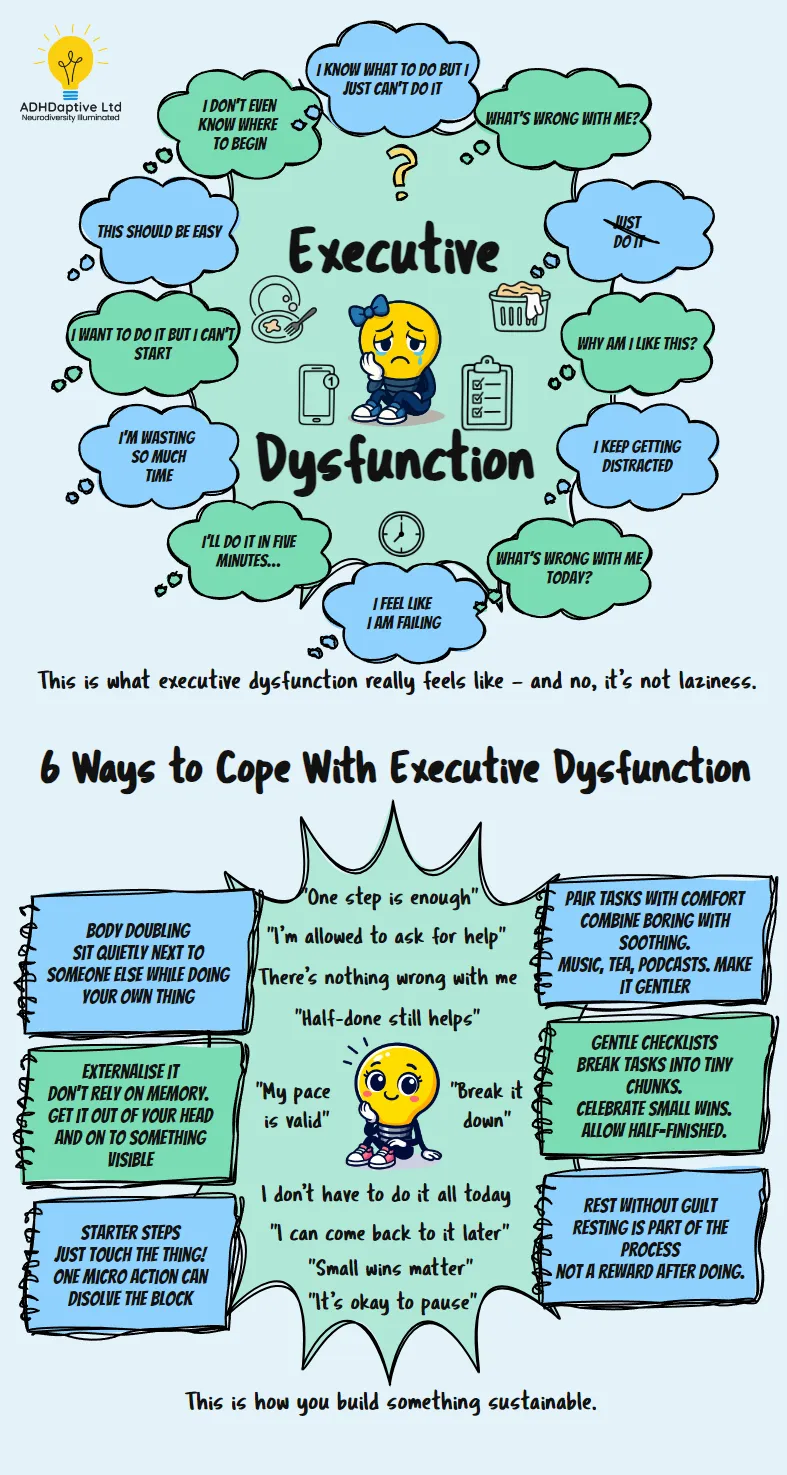
This infographic may be hard to read on smaller screens. Open it full size or download the image.
A gentle reminder

Executive dysfunction is not a character flaw.
You are not a failure. You are not lazy. You are doing your best with a brain that is often running uphill.
If today you answered one email, drank some water, or even just noticed you were stuck, that is enough.
You moved. You noticed. You tried.
That matters.
Frequently asked questions
What is executive dysfunction?
Executive dysfunction is difficulty with the brain skills that help you start tasks, plan steps, switch focus, manage time, regulate emotions and finish things. For ADHD adults, it can feel like being stuck even when the task matters.
Is executive dysfunction the same as laziness?
No. Laziness is not the right explanation. Executive dysfunction is often a neurological block where you want to act, know what needs doing, and still cannot make your brain or body move.
What does executive dysfunction feel like?
It can feel like thinking about a task all day but not starting, freezing halfway through, losing the thread, avoiding simple messages, or feeling trapped between two small choices and doing neither.
What helps when executive dysfunction makes you stuck?
Useful supports can include body doubling, starter steps, written prompts, external reminders, softer checklists, fewer decisions, rest before burnout, and asking someone to help break the task down.
Can ADHD coaching help with executive dysfunction?
ADHD coaching can help you notice patterns, reduce pressure, build practical systems, and find ways to start and finish tasks without relying on panic, shame or last-minute crisis energy.